
Recovery from addiction rarely comes down to willpower alone. Substance use alters the brain, reshapes habitual responses, and calls for new coping skills to hold long‑term change. This article outlines why motivation by itself often isn’t enough, which practical cognitive tools lead to lasting progress, and how evidence‑based therapies, CBT, DBT and Equine‑Assisted Learning are combined in integrated dual‑diagnosis care.
You’ll find clear, research-aligned explanations of relapse neurobiology, straightforward techniques for managing cravings and emotion dysregulation, and concrete examples of how structured programs help people translate skills into everyday life. We also define “dual diagnosis,” explain why treating mental health and substance use together improves outcomes, and describe how residential and outpatient pathways support long‑term stability.
Throughout, the focus is practical and trauma‑informed: guided skills training, experiential practice, and measurable approaches families and clinicians can use when choosing a program or building an aftercare plan.
Why is willpower alone insufficient for lasting addiction recovery?
Willpower describes the attempt to resist urges, but addiction rewires the brain’s reward and control systems so urges gain strength and decision‑making becomes harder. Repeated use reinforces habit circuits and increases stress reactivity, which makes motivation fragile in high‑risk moments. Environmental cues, social pressures, and untreated mental health symptoms can all trigger conditioned responses that overwhelm self‑control unless a person has practiced concrete coping skills. Understanding these mechanisms explains why relapse is common and why structured, skills‑based interventions are needed to rebuild regulation and reduce risk. The section that follows summarizes what current research and leading authorities say about these limits and what that means for treatment choices.
What does research say about the limits of willpower in recovery?
Evidence shows that relying on willpower alone produces low long‑term abstinence rates because addiction reflects neuroadaptive changes in reward and stress systems, not merely a matter of choice. Major public health organizations and recent studies report better outcomes from structured treatments that combine psychotherapy and psychosocial supports; integrated programs reduce fragmented care and improve continuity.
For example, evaluations show behavioral interventions that teach coping skills and relapse‑prevention strategies lower return‑to‑use compared with unsupported attempts at abstinence. These findings encourage clinicians to prioritize evidence‑based therapies over motivational exhortation: durable recovery rests on building cognitive and behavioral competencies, not only on increasing motivation. That brings us to the specific cognitive tools that build those competencies.
How do cognitive tools provide a more effective path beyond willpower?
Cognitive tools are repeatable techniques that change how people notice triggers, manage strong emotions, and act under stress, skills that remain useful when motivation wanes. Examples include cognitive restructuring to reframe craving‑related thoughts, behavioral activation to restore rewarding sober activities, and distress‑tolerance strategies to reduce impulsive reactions in crisis.
Each tool targets a mechanism: thought work breaks automatic craving loops, behavioral experiments test risky assumptions, and mindfulness creates a pause that allows chosen responses. In practice, these techniques produce lasting behavior change by shifting underlying cognitive and emotional processes. They’re taught, practiced, and reinforced in clinical settings so clients can use them outside treatment. Next we define dual diagnosis and explain why integrated care matters for applying these strategies.
What is dual diagnosis and why is integrated treatment essential?

“Dual diagnosis” refers to a person who has both a substance use disorder and one or more mental health conditions, which calls for coordinated care that addresses both simultaneously. Treating each condition separately risks symptom substitution, fragmented care, and poorer long‑term outcomes. Integrated approaches align psychotherapy and relapse‑prevention skills within a single, consistent plan.
Integrated care avoids conflicting recommendations, improves overall care management, and lets clinicians tailor cognitive tools to how mood, trauma and substance‑related triggers interact. In residential settings that follow dual‑diagnosis best practices, providers commonly combine evidence‑based therapies with experiential modalities to treat the whole person.
With that context, the next subsection lists co‑occurring disorders often seen alongside addiction and what they imply for treatment.
Which mental health disorders commonly co‑occur with addiction?
Depression: Often requires concurrent mood management and behavioral activation to counter anhedonia that can drive substance use.
Anxiety disorders: Panic and generalized anxiety raise avoidance and self‑medication risks, making exposure‑based skills and mindfulness especially useful.
PTSD and trauma‑related conditions: Trauma symptoms can fuel substance use as a coping strategy, so trauma‑informed stabilization is essential before deeper processing.
Bipolar disorder and ADHD: Mood instability and attention challenges need coordinated care alongside tailored behavioral strategies.
How does integrated dual‑diagnosis treatment improve recovery outcomes?
Integrated care brings psychotherapy and psychosocial supports together so clinicians treat interacting symptom systems rather than isolated problems. Evidence shows integrated programs reduce substance use, improve psychiatric symptoms, and increase engagement in aftercare compared with fragmented services.
Key mechanisms include synchronized treatment that stabilizes mood while cognitive therapies address cravings, plus combined skills training that rehearses emotion regulation in substance‑related situations. Integrated care also lowers dropout by simplifying access and clarifying goals, which supports sustained recovery. With these principles in mind, the next major section covers a foundational therapeutic tool: cognitive behavioral therapy.
How does Cognitive Behavioral Therapy support addiction and mental health recovery?

Cognitive Behavioral Therapy (CBT) is a structured, skills‑focused psychotherapy that links thoughts, emotions and behaviors to reduce substance use and improve co‑occurring mental health symptoms. CBT helps people spot automatic thoughts that trigger cravings, test unhelpful beliefs with behavioral experiments, and practice alternative coping responses until they become habitual. CBT’s strengths for dual diagnosis include clear session structure, measurable skill development, and flexibility for mood disorders and trauma stabilization. Programs commonly combine individual CBT with group skills practice so clients learn concepts and then apply them in social, real‑world contexts. The subsection below lists core CBT techniques used in addiction and dual‑diagnosis care.
What are the key techniques of CBT for changing unhelpful thinking?
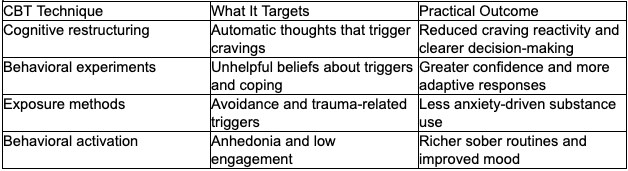
Cognitive restructuring: Identify and challenge distorted automatic thoughts that fuel craving or hopelessness.
Behavioral experiments: Test predictions (for example, “If I face this trigger sober, I’ll fail”) to gather corrective evidence.
Exposure and habituation: Gradual, supported contact with anxiety‑ or trauma‑related cues to reduce avoidance‑driven use.
Behavioral activation: Schedule rewarding, substance‑free activities to rebuild positive reinforcement.
(What follows is a practical mapping: the table below shows how specific CBT techniques target problems and the outcomes programs aim for in dual‑diagnosis care.)
How does Dialectical Behavior Therapy help manage emotions and prevent relapse?

Dialectical Behavior Therapy (DBT) is a skills‑based approach that teaches mindfulness, distress tolerance, emotion regulation, and interpersonal effectiveness to reduce impulsive behaviors, including substance use. DBT helps people notice urges without acting on them, tolerate intense distress safely, and build routines that lower relapse vulnerability when emotions run high. Its structure, skills groups, phone coaching and individual therapy, supports transferring skills into everyday crises, which is especially helpful for people with high emotional reactivity or histories of self‑harm.
Research shows DBT reduces self‑injury and can lower substance‑related impulsivity, particularly when combined with CBT and appropriate clinical care.
What DBT skills are taught for emotional regulation and coping?
Mindfulness: Notice urges and emotions nonjudgmentally to create space before reacting.
Distress tolerance (TIP, paced breathing): Use grounding and breathing techniques to get through crises without using substances.
Emotion regulation: Identify triggers, reduce vulnerability factors, and practice opposite‑action strategies to shift mood.
Interpersonal effectiveness: Communicate needs and set boundaries to lower relational stress that can lead to use.
(Use case snapshot: the table below links DBT skills to common scenarios and recovery benefits.)
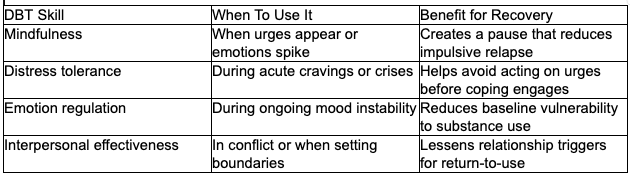
This comparison clarifies how DBT modules address common relapse scenarios and helps clinicians design targeted practice. Next, we turn to experiential learning with equine‑assisted modalities.
Why is DBT especially effective for co‑occurring disorders?
DBT’s practical, skill‑building focus fits people with borderline traits, PTSD‑related reactivity, or severe mood instability because it provides concrete alternatives to impulsive coping. By teaching crisis survival strategies and sustainable emotion‑regulation techniques, DBT reduces the frequency of high‑risk episodes that often lead to substance use.
When combined with CBT and appropriate supports, DBT helps turn symptom stabilization into everyday functional skills. Integrated residential settings can deliver DBT repeatedly in group and individual formats, improving generalization and lowering relapse risk after discharge. The next section explores how Equine‑Assisted Learning complements these cognitive approaches.
What role does Equine‑Assisted Learning play in holistic addiction recovery?

Equine‑Assisted Learning (EAL) is an experiential approach that uses guided interaction with horses to develop self‑awareness, trust and nonverbal communication skills that support emotion regulation and trauma processing. Horses provide immediate, nonjudgmental feedback that reflects a person’s emotional state, helping clients notice bodily cues and relational patterns often linked to substance use. EAL is especially useful for people who find talk therapy difficult: it offers opportunities to practice boundaries, assertiveness and co‑regulation in embodied, real‑world exercises. Ethical delivery requires trained facilitators, clear safety protocols, and integration with evidence‑based therapies so experiential gains translate into cognitive and behavioral change. The next subsection illustrates these mechanisms through a sample EAL exercise.
How does interaction with horses facilitate emotional growth and trauma processing?
EAL supports growth through mirroring, immediate feedback and guided reflection: horses respond to subtle nonverbal signals, revealing how anxiety, avoidance or aggression show up in behaviour. A typical exercise, such as a boundary‑setting groundwork task, asks a client to lead or halt a horse using posture and intention; the horse’s reaction provides material the therapist uses to coach alternative approaches. This work anchors trauma processing in present‑moment safety and builds somatic awareness that complements cognitive reframing.
Practitioners pair EAL with trauma‑informed pacing, ensuring consent and stabilization come before deeper emotional work. The next subsection contrasts EAL with traditional cognitive tools and explains how they work together.
What makes equine therapy a valuable complement to traditional cognitive tools?
Equine assisted learning strengthens cognitive skills through embodied practice: clients bring mindfulness, distress tolerance and interpersonal strategies learned in CBT or DBT into interactions with a horse, accelerating learning through immediate feedback. For those who resist verbal processing, EAL offers another route to insight and skill acquisition that transfers to human relationships and relapse triggers.
In a program, EAL sessions are followed by cognitive processing so observations become concrete coping plans, creating a loop of experience → reflection → rehearsal. Safety and facilitator credentialing are essential; experiential work is most effective when embedded in a broader, evidence‑based treatment plan. The following section explains how these tools are woven into real program structures at a residential provider.
How do Dunham House’s programs integrate cognitive tools for comprehensive recovery?
Dunham House operates English‑language residential dual‑diagnosis programs on an 85‑acre Quebec campus, combining evidence‑based therapies, CBT, DBT and Equine‑Assisted Learning, within a trauma‑informed residential model. Programs are designed to stabilize substance use and symptoms, teach cognitive and behavioral skills, and support the transition to community aftercare. Residential intensity allows daily skills practice in individual and group formats, coordinated multidisciplinary care, and scheduled experiential sessions on our nature campus to reinforce learning. Outpatient services provide continuity after discharge, with group relapse‑prevention, ongoing therapy and coordination with community resources. Below is a practical overview of program options and typical outcomes to help families and clinicians choose the right pathway for a given clinical profile.
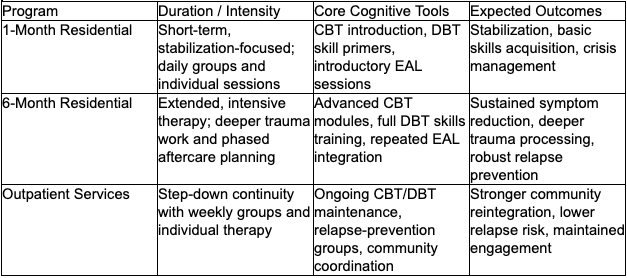
This comparison illustrates how program length and intensity shape which cognitive tools are emphasized and the outcomes they most reliably support. The next two subsections describe residential features and outpatient supports in more detail.
What are the features of the 1‑Month and 6‑Month residential dual‑diagnosis programs?
Both residential tracks deliver integrated treatment but differ in scope and depth.
The 1‑Month program emphasizes rapid stabilization, comprehensive assessment, and introduction to core coping skills through daily CBT/DBT groups and select EAL experiences.
The 6‑Month program builds from that foundation with extended individual trauma work, more intensive DBT and CBT cycles, repeated equine modules, and structured aftercare planning to support lasting change. Staffing includes multidisciplinary teams who coordinate care and psychotherapy, while the campus provides safe opportunities to practice social and recreational recovery skills.
Expected outcomes vary by length: the longer track permits deeper processing and stronger consolidation of relapse‑prevention skills. The following subsection addresses outpatient continuity.
How do outpatient services support ongoing recovery and relapse prevention?
Outpatient services function as step‑down care to maintain skills learned in residential treatment and to provide flexible support for people living in the community. Typical offerings include weekly CBT or DBT sessions, relapse‑prevention groups, regular check‑ins, and coordination with community supports for housing, employment and social reintegration. These services benefit clients leaving residential care as well as individuals needing lower‑intensity support. By reinforcing cognitive tools in real‑life settings, outpatient care eases transitions and helps preserve gains that can fade when supports stop. Dunham House’s residential and outpatient pathways are structured to match intensity to clinical need and to prioritize safe, evidence‑based practice.
Program note: Dunham House is an English‑speaking, non‑profit residential treatment centre in Quebec specializing in integrated addiction and mental health care on a nature campus.
Location: The facility is located on an 85‑acre campus in the Eastern Townships, with experiential settings for Equine‑Assisted Learning.
Contacting the program: For inquiries or compassionate admissions guidance, call Dunham House at (450) 263‑3434 or visit the organization’s program information resources.
(Program summary table: the table below consolidates features, intensity, and primary therapeutic focus for quick comparison.)
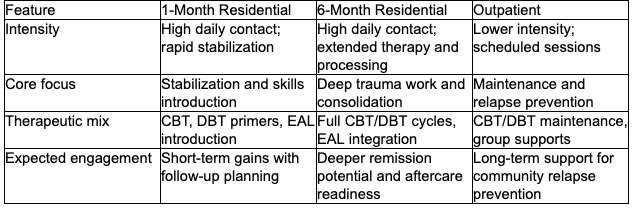
This side‑by‑side view helps prospective clients and families weigh program fit based on clinical goals and the need for intensive skill building versus maintenance. Below are clear, actionable next steps for readers evaluating options.
When evaluating treatment options, prioritize programs that:
Offer integrated care for both substance use and co‑occurring mental health conditions.
Deliver evidence‑based therapies (CBT, DBT) with measurable skills practice.
Include experiential components (such as EAL) and use trauma‑informed pacing.
These criteria point to services that build cognitive tools rather than relying on motivation alone. Choosing a program with coordinated outpatient continuity further increases the chance of durable recovery gains.
Practical tips for applying cognitive tools in daily recovery:
Practice a brief DBT distress‑tolerance skill each day so it’s available during crisis.
Use quick cognitive‑restructuring prompts when cravings arise to test automatic thoughts.
Schedule one or two behavioral‑activation activities each week to rebuild rewarding, sober routines.
Regular rehearsal and community support turn therapeutic insights into reliable habits that last beyond treatment.
Signs a dual‑diagnosis program follows best practices:
Multidisciplinary coordination between therapies for synchronized care.
Structured skills groups alongside individual therapy and experiential opportunities.
Clear aftercare planning and step‑down outpatient supports.
Choosing programs that meet these standards improves the chances that cognitive tools will translate into lasting recovery.
This article has combined neuroscience, therapy mechanisms, experiential learning and program design to explain why willpower alone rarely produces lasting recovery, and how cognitive tools, delivered in integrated, trauma‑informed programs, support durable change.
Conclusion
Supporting your recovery means acknowledging that willpower on its own is often not enough. Integrating practical cognitive tools with evidence‑based therapies is essential for lasting change. By choosing a program that treats both substance use and co‑occurring mental health conditions, you can build the skills needed for sustainable recovery.
Learn more about Dunham House programs to find the right fit, and take the first step toward a healthier future by contacting us today.

Dunham House
About Dunham House
Located in Quebec's Eastern Townships, Dunham House is a residential treatment centre specializing in addiction and providing support to individuals with concurrent mental health challenges. We are the only residential facility of our kind in Quebec that operates in English.
Our evidence-based programs include a variety of activities such as art, music, yoga, and equine-assisted therapy. In addition to our residential services, we offer a full continuum of care with outpatient services at the Queen Elizabeth Complex in Montreal.