
Three meals, same time: the recovery habit nobody talks about
It is 4:10 in the afternoon, and this is the third week since you have stopped drinking, with the craving suddenly appearing. Your hands are slightly unsteady, your patience is completely gone and your brain is now arguing in favour of 'just one'. When was the last time you ate? You had coffee at about 7 and had eaten half a muffin that you didn't finish.
What most people would describe that moment as is a trial of willpower; most of the time the reason is hunger (and no one likes finding out that the solution to a craving could be a sandwich).
At Dunham House we plan meals with the same care that we apply to therapy, follow-ups and dual diagnosis assessment. It may sound rather elementary to regard eating at the same time every day as a form of treatment, but biology contradicts this view, beginning with the body's internal clocks.

Your body keeps time on more than one clock
The principal clock is located in your brain and generally gets its signals from light. Your liver, gut and other organs also have their own clocks, these being sensitive to the time at which food arrives. If you eat at about the same hours each day, the various clocks will begin to align with one another and sleep and digestion will then take on a pattern that you can predict.
Different substances have different effects in pulling the system apart. Alcohol damages the second half of the night's sleep. Stimulants stop the appetite for hours before causing a drop in energy, and opioids slow down digestion until hunger is almost ignored. Once mornings have been missed for months or years and dinners are being eaten at eleven p.m., the body clocks become desynchronized.
Depression and anxiety are also associated with a disturbed body clock, and poor sleep and a low mood reinforce one another in a cycle that is difficult to break from within. In people who have both an addiction and a mental health condition, the body clock is generally part of both issues.
You can't force yourself to sleep better, but if you decide that breakfast will be at 8, your body will begin to adjust to this schedule.
Hungry, angry, lonely, tired
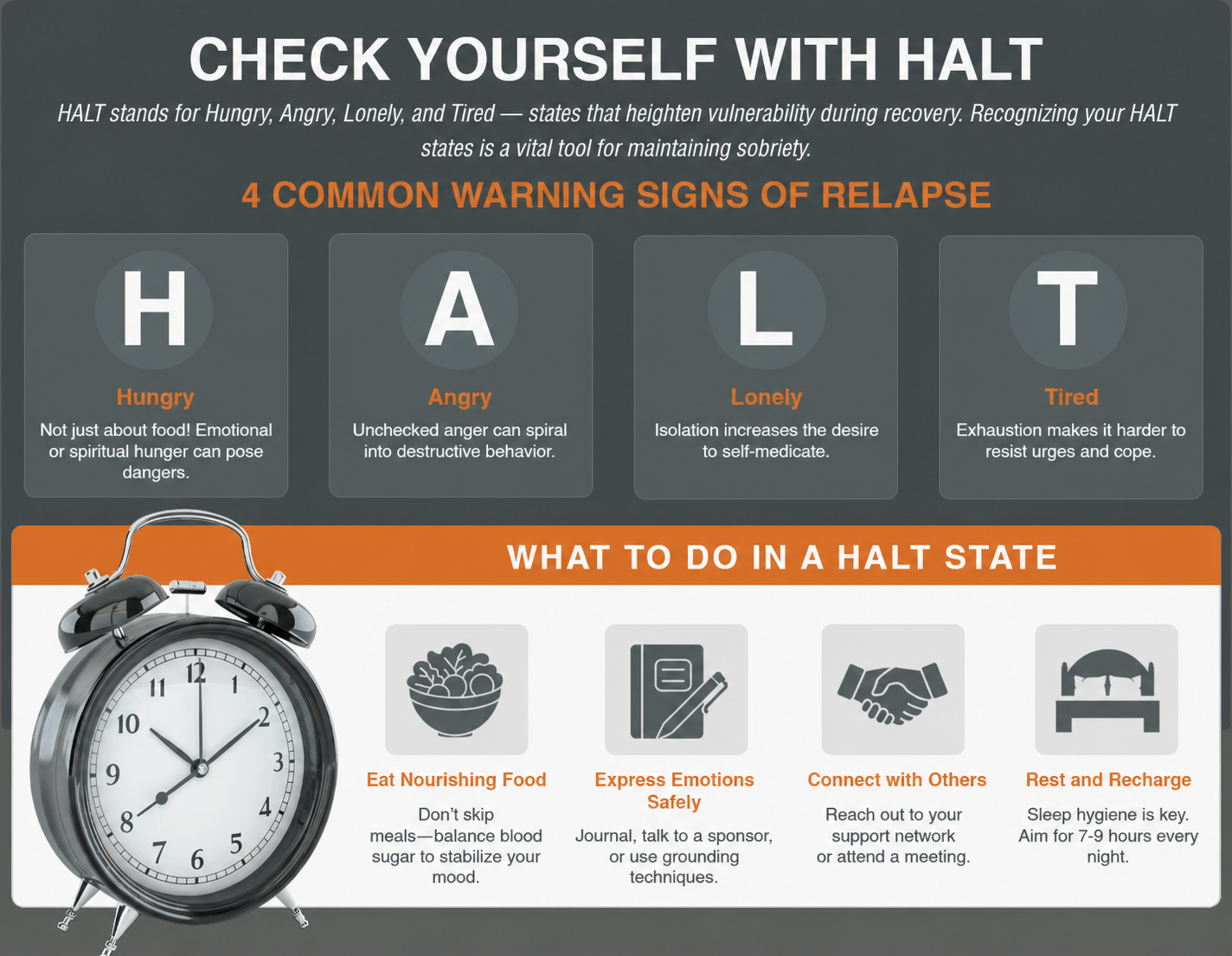
HALT is an old-term shorthand for recovery, and the reason hungry comes first is clear.
When your blood sugar levels fall, your body secretes adrenaline and cortisol in order to raise them again; as a result your heart rate increases, you become irritable, your hands start to shake and your concentration is affected. The symptoms are so similar to anxiety that most people aren't able to tell the two apart, and in the early stages of recovery it can seem exactly like a craving since your brain has for years associated a drink or a pill with the cessation of that sort of discomfort.
Eating at regular intervals helps to keep your blood sugar levels more stable, so you'll experience fewer of those afternoon crashes. You'll still have cravings, but you can remove hunger from your list of triggers right now.
When depression makes eating feel impossible

Depression can cause appetite to disappear altogether or instead lead people to choose whatever requires the least effort and to eat it at the first hour they remember. In both cases, the low mood gets worse: if you skip lunch you'll be worse off by six o'clock and will have nothing left with which to cook.
Depression sufferers are treated by a method known as behavioural activation, which involves arranging small actions ahead of any motivation appearing and then allowing the mood to catch up afterwards. Eating at a set time is a good example of this. It provides the day with a fixed point and a small task to complete. On a bad day, this could simply be having toast at 8, and that is acceptable.
What your brain makes from food
The chemical messengers in your brain are produced on the basis of the food you eat; serotonin, which plays a role in mood and sleep, is derived from the amino acid tryptophan, while dopamine and norepinephrine, which are associated with motivation and focus, are obtained from tyrosine, the conversion to these neurotransmitters requiring B vitamins and minerals at various stages.
The prolonged use of drugs depletes those reserves; in the case of heavy drinking, the body's ability to absorb and store thiamine (vitamin B1) is disrupted, and low levels of thiamine have an effect on memory and mood. Many people who get into treatment have deficiencies that had never been looked for before.
There is also the link between the gut and the brain. The gut produces a major portion of the body's serotonin and communicates with the brain via nerves, hormones and the immune system. Although the research in this area is still in its early stages, anyone promoting a 'mood diet' is going ahead of the evidence. It is reasonable to state that the times at which you eat and the type of food you eat influence how you feel.
Fewer decisions in a hard season
Recovering in the early stages is mentally costly since you have to learn new ways of coping, accept the emotions you used to dull, and work towards reestablishing trust with the people you care about, all while having to make numerous small decisions that were once made automatically.
A routine when it comes to food eliminates a number of the options. It explains both why you feel off at 3 p.m. and whether or not you should eat, directing your energy towards more useful things.
Addiction also causes days to be unpredictable. The knowledge that lunch will be ready on the table both tomorrow and the day after that provides a nervous system that has been on high alert for a long time with some proof that things are stable. For many of those in treatment, meals turn out to be the first part of the day that they can rely on.
John's kitchen, and the greenhouse behind it

John, our gardener and head chef, taking care of the garden.
The meals served at Dunham House are prepared each day according to a fixed schedule in our own kitchen. The chef, John Look, grows vegetables in the Campbell Hendery Healing Garden on campus and organizes the menu around the vegetables he harvests. Almost all of the food that the customers eat is grown just a short walk from the dining room.
Good food here does more than taste good. Recovery is hard work, and some days are heavy. A morning spent talking through old pain and an afternoon in group can leave anyone running on empty. A good meal, served at the same time every day, gives people the energy to keep showing up for themselves.
The table is important as well since eating a proper meal while sitting down with other people in the quiet of the Eastern Townships helps to restore a habit that addiction tends to weaken. It may take a few days to get used to this if you've been eating standing at the counter or not at all.
We do not treat food as a substitute for clinical care. Instead, it supports the 1-Month , the 3 or 6-Month Programs and our outpatient services.

Dunham House
About Dunham House
Located in Quebec's Eastern Townships, Dunham House is a residential treatment centre specializing in addiction and providing support to individuals with concurrent mental health challenges. We are the only residential facility of our kind in Quebec that operates in English.
Our evidence-based programs include a variety of activities such as art, music, yoga, and equine-assisted therapy. In addition to our residential services, we offer a full continuum of care with outpatient services at the Queen Elizabeth Complex in Montreal.