
If you or someone you love is ready to stop drinking or using drugs the words can get extremely confusing very quickly. Detox, rehab, withdrawal management, residential treatment... are they all the same? That's what people are asking when they search 'detox vs rehab' and they're looking for a simple answer and a clear next step.
Below we look at what detox is, what rehab is, how the two fit together and why the step after detox is so important. You'll also find Quebec resources to help you get started.

What is detox (withdrawal management)?
"Detox" is the term used for withdrawal management. Health Canada defines it as the initial period of supervised and controlled cessation of a substance. Its purpose is to help the body get through withdrawal as safely and comfortably as possible.
Withdrawal can cause symptoms such as anxiety, shakiness, nausea, poor sleep and pain. In some cases (e.g. alcohol) it can be severe and even life-threatening. That's why the Canadian Centre on Substance Use and Addiction (CCSA) states that a doctor or other health professional can help you determine whether you need detox and what type of detox is most appropriate for you.
There are a few kinds of detox in Canada:
Medical detox: medical staff are involved and where necessary medications will be used to help with the symptoms.
Social detox: a supportive, supervised environment without any medication.
Home-based withdrawal: in some areas you'll have a health care team to support you as you withdraw at home.
Detox is typically short. CAMH notes that alcohol withdrawal can start as early as 6-12 hours after the last drink, peak on day 2 or 3 and can go on for up to a week. Other substances have different timelines and of course every individual is different.
What is rehab (residential treatment)?
"Rehab" generally means residential (in-patient) treatment. CCSA describes these as structured live-in programs where people receive support for their substance use and for their general health and well-being.
Where detox is about the body, rehab is about the person. It's the opportunity to get to the root of why you started using and to develop the tools to live a different life. Depending on the program, residential treatment will include:
Individual and group counselling
Evidence-based therapies such as cognitive behavioural therapy (CBT), dialectical behaviour therapy (DBT) and motivational interviewing
Care for mental health concerns that often travel with substance use, like anxiety, depression or trauma
Routines, life skills and relapse-prevention planning
Family involvement and aftercare planning
Programs vary from a few weeks to several months. At Dunham House the residential programs range from 30 days to 90 days and 6 months, and are all dual diagnosis programs (substance use and mental health are treated together).
Detox vs rehab at a glance
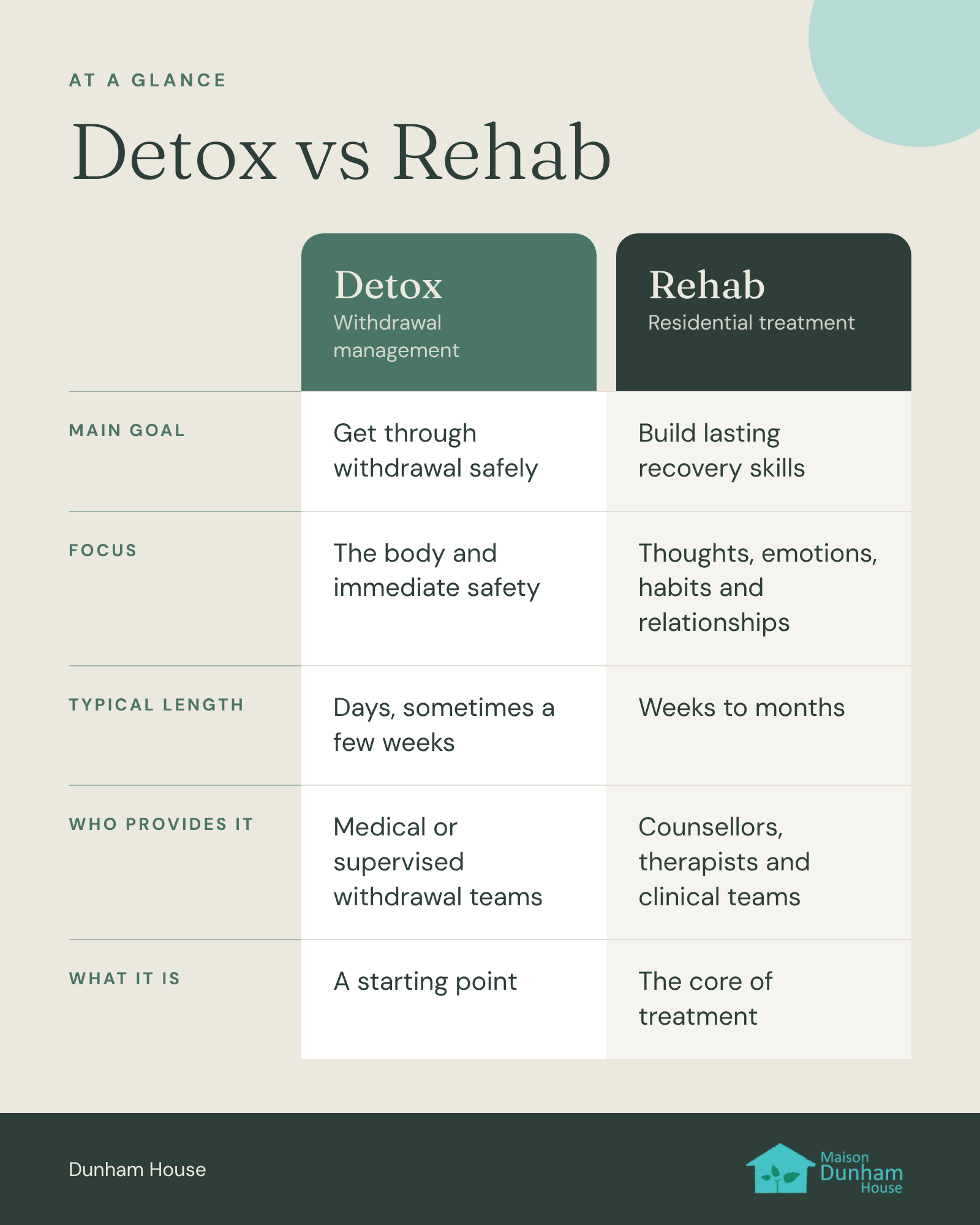
Detox gets you to stop. Rehab is where you learn to stay stopped and build a life you don't want to run away from.
Why detox alone usually isn't enough
It's quite natural to feel a sense of relief once the withdrawal has actually passed. Detox doesn't however get to the root of why the substance use began in the first place, nor does it deal with the stress, the pain and the patterns that are the very thing that perpetuates the use.
Canadian health organizations are clear on this. Health Canada recommends moving straight from withdrawal management into substance use and mental health services, because the risk of relapse and harm is high. The CCSA treatment guide is even more direct in stating that withdrawal on its own is not treatment, though it can be a very useful first step.
There's also a safety reason. Following a period of abstinence, tolerance falls. CCSA cautions that if you then go back to using the same amount as before, the risk of overdose is dramatically increased. This is particularly the case with opioids. With respect to opioid use disorder, Health Canada states that withdrawal management on its own is neither effective nor safe and that care will typically involve medication-assisted treatment and continued support. More information is available in our article on overdose risk following rehab.
Relapse is very common, and many people in recovery go through it. It's not a failure. A good plan in place for what happens after detox however can make the months after it considerably safer and more stable.
How detox and rehab fit together in Quebec

For a lot of people it goes assessment, then detox if required, then treatment, then aftercare. The key is to have the next step planned before detox finishes so there's no gap.
In Quebec, here's where you can start:
Your family doctor (if you have one) can assess your health and refer you.
Your local CLSC (Accueil psychosocial) can assess your needs and refer you on to the appropriate services. The public addiction rehab centres (e.g. Centre Jean-Patrice-Chiasson in Sherbrooke or the Centre de réadaptation en dépendance de Granby in the Eastern Townships) provide free, confidential, bilingual services (including detox if required).
Drogue : aide et référence (1-800-265-2626) gives information and referrals in both languages, at any time, anywhere in Quebec.
Info-Social 811 connects you with a psychosocial professional 24 hours a day, 7 days a week.
A note on Dunham House and detox: we don't offer detox on site. Anyone who needs detox will do it before they arrive.
Our admissions team can advise you on timing so that the move from detox into residential care is as smooth as possible. You can also have a look at our admissions criteria and the admissions process.
A few questions to ask while you plan:
Do I need a detox and if so which type is right for me?
How long will my withdrawal last?
Where will I be when detox is over?
Who can help me apply to a treatment program now rather than later?
Is there support available for my mental health as well as my substance use?
Not sure you need a live-in program? Our guide to inpatient vs outpatient rehab will help you compare the options.
For families: helping with the handoff
If you're supporting a loved one the period between detox and treatment can be quite fragile. You can't control what they do, but you can certainly help to remove the barriers.
Learn the plan together. Find out what happens after detox and help to piece the details together.
Help with the logistics. The admin stuff, the rides, the time off work and the packing can all seem like a massive undertaking in the early days of recovery.
Keep your words gentle. Shame will push people away. Curiosity and care will keep the door open. Our guide on how to talk to a loved one about rehab contains some practical scripts.
Look after yourself. Family support is important. Find out more about our family program.
When to seek help

You don't have to wait for things to get worse before you get in touch. It may be time to speak to someone if:
You've tried to cut back or stop and found it hard to keep going
You feel shaky, sick or anxious when you go without a substance
Substance use is affecting your health, work, relationships or mood
You've finished detox before but didn't have a plan for what came next
If you'd like to talk about residential treatment our Admissions Care Team is here to listen and answer your questions (no pressure). Call us at 450-263-3434, option 1; contact us online or email admissions@dunhamhouse.ca to get the conversation started.
Frequently asked questions
Is detox the same as rehab?
No. Detox (withdrawal management) will get you through withdrawal safely. Rehab (residential treatment) is a longer program which helps you to develop skills and look at the reasons why you were using. Many people will need both, one after the other.
Do you need a detox before rehab?
It's going to depend on the substance, the amount and duration of use and your own health. A doctor or health professional would be in a position to determine whether you need some form of withdrawal management. Some of the residential programs (Dunham House for example) will require that you have completed your detox prior to admission.
How long does detox take?
It's variable. Alcohol withdrawal typically lasts several days to about a week (per CAMH), although some of the symptoms (e.g. poor sleep) can persist beyond that. Other substances have different timelines.
Can you detox at home?
Some areas do have supported home withdrawal with a health care team. Given that withdrawal from certain substances (alcohol being a prime example) can be dangerous, the Canadian health agencies recommend that you talk to a health professional prior to attempting to stop on your own.
What happens after detox?
Ideally you'd go straight into treatment (residential or outpatient) following detox and then onto aftercare. Planning that out before detox finishes can really help lower the risk of relapse and overdose.
If you or someone you love is in crisis, call or text 9-8-8 (Suicide Crisis Helpline, 24/7), call 1-866-APPELLE (1-866-277-3553) in Quebec, or 911 in an emergency. For substance-use help and referrals in Quebec: Drogue : aide et référence, 1-800-265-2626, or Info-Social 811.

Dunham House
About Dunham House
Located in Quebec's Eastern Townships, Dunham House is a residential treatment centre specializing in addiction and providing support to individuals with concurrent mental health challenges. We are the only residential facility of our kind in Quebec that operates in English.
Our evidence-based programs include a variety of activities such as art, music, yoga, and equine-assisted therapy. In addition to our residential services, we offer a full continuum of care with outpatient services at the Queen Elizabeth Complex in Montreal.