
Overdose Risk After Rehab: What to Plan For in the First Weeks Home
Someone finishes a residential program looking healthier than they have in years. Sleep has returned. Colour is back. Family members exhale for the first time in eighteen months. Three weeks later, that same person is in an emergency department.
Overdose risk after rehab rises at the exact moment the people around a person start to relax. The reason sits in the body, not in anyone's character. Understanding the mechanism gives families and people in recovery something concrete to plan around, and August 31, International Overdose Awareness Day, is a reasonable prompt to build that plan before it is needed.

Tolerance falls while the drug supply stays unpredictable
Opioid tolerance is a physical adaptation. The body adjusts to a repeated dose, and it un-adjusts when the dose stops. A few weeks without opioids in a residential program reverses months of adaptation.
The danger shows up when someone returns to a dose that felt routine before treatment. A systematic review of residential opioid use disorder treatment published in Substance Abuse and Rehabilitation describes the mechanism plainly: after treatment, tolerance may be lower, and taking a pre-treatment quantity can push someone into an overdose or hospitalization. (Dove Medical Press, 2025)
The second half of the problem is the supply. Someone who used two years ago is not returning to the same drug they left. Of apparent opioid toxicity deaths in Canada in the first half of 2025, 83% involved non-pharmaceutical opioids and 68% also involved a stimulant. (Public Health Agency of Canada)
A lower tolerance meeting an unpredictable supply is the combination that makes the post-discharge window so serious.
What Canada's numbers say in 2026
The national picture has improved. Canada recorded roughly 5,630 opioid toxicity deaths in 2025, a 23% decline from the previous year, following a 17% drop in 2024. Federal health officials credited naloxone distribution and shifts in the drug supply, while describing the progress as uneven and fragile. (CBC News, June 2026)
That still works out to about 15 deaths a day. And 97% of apparent opioid toxicity deaths reported in the first half of 2025 were accidental, which tells you these were not people trying to die. They were people who miscalculated a dose, or used a supply that was stronger than the last one.
For a family bringing someone home from treatment, the national trend line matters less than the specific weeks in front of them.
Why co-occurring conditions raise the stakes

Substance use and mental health conditions travel together often enough that treating one without the other leaves a driver in place. That is the core argument for dual diagnosis care, and it applies with particular force to the post-discharge window.
The evidence points in a consistent direction. The same review of residential treatment outcomes identifies co-occurring mental health disorders, greater substance use disorder severity, higher stress, younger age, and weaker social support among the factors associated with a greater risk of returning to substance use after discharge. (Dove Medical Press, 2025)
Research on people who stop buprenorphine treatment found that emergency department visits stayed high across all groups in the six months afterward, with the highest rates among people living with mental illness. (Columbia University Department of Psychiatry)
Benzodiazepines add another layer. A study published in the American Journal of Psychiatry found that benzodiazepine use in the 28 days before starting medication for opioid use disorder predicted overdose risk during treatment, and noted that benzodiazepine use can mark co-occurring mental health problems while also deepening the respiratory depression opioids cause. (American Journal of Psychiatry)
There is a practical version of all this. A person whose panic attacks, depression, or post-traumatic symptoms went unaddressed during treatment leaves with the original reason for using intact. Detox removed the substance. The distress that the substance was managing is still there on day four at home, at two in the morning, with the pharmacy closed and no appointment until October.
Four transitions that deserve a written plan
Risk clusters around specific handoffs. Each one deserves its own preparation rather than a general intention to be careful.
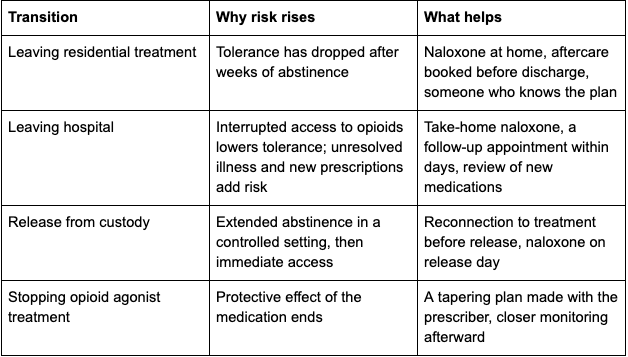
A case-crossover study in the Journal of Hospital Medicine found that both physician-advised and before-medically-advised hospital discharges were associated with transient increases in overdose risk, with the before-medically-advised group at roughly double the risk. (Journal of Hospital Medicine, 2025)
What a discharge safety plan includes

A safety plan works best when someone writes it down before discharge, while thinking is clear and the clinical team is still in the room.
Naloxone in the home, and someone trained to use it. In Quebec, naloxone is free and available without a prescription to anyone 14 and over at participating pharmacies, and some community organizations distribute it as well. You can request a kit for a household member. Locate a source through the Quebec health and social services directory.
A plan for not being alone. The National Overdose Response Service operates a free, confidential, peer-run line at 1-888-688-6677, available across Canada 24 hours a day. A virtual supervisor stays on the call and contacts emergency services if the caller stops responding.
Clarity about calling 911. Canada's Good Samaritan Drug Overdose Act protects the person experiencing an overdose and anyone who calls for help from charges for simple possession. Families often hesitate at this exact moment, and the hesitation costs minutes that matter.
Continuing care booked before the discharge date. Aftercare that already has a date and a name attached survives the first difficult week better than a referral list.
Mental health treatment that continues without a gap. If a psychiatrist, prescriber, or therapist was part of the residential program, the person leaving needs an equivalent in the community starting the same week.
A short list of people who can be called without explanation. Two names is enough. The point is removing the step where someone has to justify the call.
Clinical note. According to the Public Health Agency of Canada, 97% of apparent opioid toxicity deaths reported in the first half of 2025 were accidental, and 68% involved a stimulant alongside an opioid. Planning for overdose risk is a routine part of discharge care, in the same category as reviewing medications or booking a follow-up.
How Dunham House approaches the transition
Dunham House
Dunham House treats addiction and co-occurring mental health conditions together, through individualized care plans built by a licensed clinical team. That structure exists because of the pattern described above: when the mental health condition goes untreated, the pressure that drives substance use stays in place after discharge.
Discharge planning is part of the clinical work rather than an administrative step at the end. That includes overdose education for the person and their family, naloxone access, coordination with community prescribers and therapists, and a continuing care schedule with dates already attached to it.
That schedule has a name. Our 12-week outpatient aftercare program covers the window this article describes, from the day someone leaves residential care through the months when tolerance is lowest and the old routines are closest at hand. Participants keep working with clinicians who already know their history, which removes the referral gap where people fall out of care while waiting for a first appointment with someone new. Aftercare sessions address both sides of a dual diagnosis, so the mental health treatment that started in residential care continues without a pause.
Families are part of this. A household that understands why the weeks after treatment carry elevated risk responds differently, and faster, than one that assumes the hard part is finished.
Frequently asked questions
Does going to rehab increase the risk of overdose? Treatment reduces substance use and connects people to care. The specific window after discharge carries elevated risk because tolerance drops during abstinence, which is why discharge planning and naloxone access matter so much.
How long does the elevated risk period last? Research points to the first weeks after leaving a controlled setting as the highest-risk window. Risk declines as recovery stabilizes and continuing care takes hold.
Where can I get naloxone in Quebec? Participating pharmacies provide it free and without a prescription to anyone 14 and over, and certain community organizations distribute kits. The provincial directory lists locations.
Can I be charged if I call 911 for someone overdosing? The Good Samaritan Drug Overdose Act protects both the person experiencing the overdose and the people present from charges for simple possession. Call, stay, and wait for paramedics.
How long should aftercare last? Continuing care works best when it spans the period of highest risk rather than ending at discharge. Dunham House runs a 12-week outpatient aftercare program built around that window, with the same clinical team the person worked with in residential care.
What makes dual diagnosis treatment different? A dual diagnosis program treats the substance use disorder and the co-occurring mental health condition at the same time, with one clinical team and one care plan, rather than treating them in sequence or in separate places.
Ask our admissions team about our 12-week outpatient aftercare program. Our licensed clinical team will walk you through dual diagnosis treatment options and what continuing care looks like for you or someone you love. [Contact us] or call [phone number].
If you or someone you know is in immediate danger, call 911. For 24/7 support in Canada, call or text 988 (Suicide Crisis Helpline) or 1-888-688-6677 (National Overdose Response Service).
Results may vary. Our programs are clinically supervised by licensed professionals. This article is for educational purposes and does not replace medical advice.

Dunham House
About Dunham House
Located in Quebec's Eastern Townships, Dunham House is a residential treatment centre specializing in addiction and providing support to individuals with concurrent mental health challenges. We are the only residential facility of our kind in Quebec that operates in English.
Our evidence-based programs include a variety of activities such as art, music, yoga, and equine-assisted therapy. In addition to our residential services, we offer a full continuum of care with outpatient services at the Queen Elizabeth Complex in Montreal.