
The short version
A lot of men don't say "I'm depressed." They say "I'm fine," and then they have another drink.
Drinking or drug use and low mood often feed each other. When they show up together, it's called a concurrent disorder.
Both can be cared for at the same time. If you're worried about a man in your life, a phone call is a reasonable place to start.

It's the first week of November in the Eastern Townships. The maples on our 85 acres have long since dropped their leaves and the fields are all grey-brown by 4.30. Some bloke is somewhere lacing up for Tuesday night hockey. His mate asks him how he's getting on. "Fine." That's the answer again.
Movember is the month that men grow moustaches for a cause and it's also men's mental health awareness month for a lot of Canadians. The second of those two things is the one that deserves more attention than the moustache. In Canada men are responsible for 3 out of every 4 suicides (PHAC). That's almost 10 men a day.
This one's about what's underneath 'fine'. It's often a drink. It might be more than one. If you'd rather just chat it through with someone then please don't hesitate to get in touch with our admissions team at any time.
What Movember is really about (and why mental health is at its heart)

Movember is a global charity which runs every November and raises funds and awareness for men's health (mental health, suicide prevention, prostate and testicular cancer). Men grow moustaches, move or host events to get the conversation started. The message is simple really: men are dying too young from preventable causes and talking about it helps.
That 'dying too young' line is straight out of Movember which states that men are dying 'too young, too often from preventable causes' (Movember).
Men are responsible for 3 out of every 4 suicides in Canada. The group with the highest rate is middle aged men (45 to 64). (PHAC)
So yes, grow the moustache. Then ask your brother-in-law how he's actually sleeping.
Why men don't ask for help
So many men learn very early on to be self-reliant, to downplay the pain and to just get on and fix things themselves. The stigma attached to asking for help is such that it's perceived as a sign of weakness and so distress tends to manifest as anger, overworking or drinking rather than as words. The very first step in the way of care is often to name what's going on and to know that help is available.
"Fine" as a default: stigma and self-reliance
Here's a figure that stopped us in our tracks. In 2022 men in Canada were more likely than women to rate their own mental health as excellent or very good. They were also almost three times more likely to die by suicide (2,688 men vs 905 women) (Stats Canada).
Read that twice. To be 'okay' on a survey and to be 'okay' in real life are not the same thing.
A lot of men were raised by men who never once said they were struggling. You fix the truck. You go to work. You don't make a fuss. That's not a character flaw, it's just what got handed down. It also means plenty of guys have never practised saying the words. Our blog on how stigma delays help-seeking goes into this more, and so does our piece on why many men hide it, especially men with demanding jobs.
Signs of depression in men that are easy to miss
In men it often presents itself as less sadness and more irritability, anger, withdrawal, fatigue, sleep problems, risk taking, drinking and drug use. Some men will work longer hours just to avoid feeling anything at all. If any of these are going on for more than two weeks and are affecting your work and your relationships then it's time to see a professional.
What that can look like in real life:
He's raging at the kids over nothing one minute and then just utterly silent for the rest of the night.
He's stopped going to the rink. Stopped going to the shop. Stopped going to wherever his friends are.
He's up at 3am scrolling, then wiped out by noon.
He takes on every overtime shift.
He drives faster than he did previously.
The beer after work used to be a pint. It's now most of a case by Sunday.
None of these individually indicate anything is wrong. It's only when you have a cluster of them over a period of weeks that you're in a position to have a proper conversation.
Men's mental health and addiction: self-medicating with alcohol and drugs

Lots of men will use booze or drugs to quiet the anxiety, depression, trauma or stress. The relief is fleeting. The substances tend to worsen the low mood and mess up the sleep, which in turn leads to more use. When a mental health condition and a substance use disorder co-exist it's known as a concurrent disorder and it generally makes sense to treat both of them in tandem.
Imagine a bloke on the night shift at a plant outside Granby. Every shift finishes with a beer in the truck before he goes home. It began as a way of coming down. Now he simply can't go to sleep without three. He wouldn't call it self medication. He'd call it Tuesday.
That's the pattern and the numbers support it. In Statistics Canada's 2012 survey men had higher rates of substance use disorders and women had higher rates of mood and anxiety disorders (Statistics Canada). One interpretation of that would be that some of the men's depression is being masked by their drinking. In 2022 drug toxicity was the cause of two in every five accidental deaths among Canadian men (Statistics Canada).
Depression and alcohol: a cycle that feeds itself
Alcohol's a depressant. It'll help for an hour and then you're paying the price the next morning. The low mood's back, a bit heavier and the easiest fix is in the fridge.
Per the Mental Health Commission of Canada, folks with alcohol use disorder are 3x more likely to have suicidal behaviours and approximately 1 in 4 suicides in Canada involves alcohol. Alcohol use disorder very frequently co-exists with major depression. If any of that is resonating with you right now, please call or text 9-8-8.
More on spotting a drinking problem in our guide to alcohol use disorder. Some men will keep the whole thing going for years whilst it's happening (we've written about functional addiction too).
What a concurrent disorder (dual diagnosis) means
A concurrent disorder (also known as a dual diagnosis) is where a person has both a mental health condition (e.g. depression, anxiety, PTSD) and a substance use problem. The two conditions feed each other so integrated care looks at both at the same time rather than in sequence which in turn supports a more stable recovery.
In practice: stop the drinking without touching the depression and the depression is still there on day ten. Work on the depression whilst the drinking is going on and the drinking will keep undoing all the work. More on concurrent disorders and on depression and addiction.
Key takeaways
' I'm fine' is the most common reply and is often not the truth.
In men depression can present as anger, overworking or drinking.
Drinking and low mood are very much linked and they tend to make each other worse.
Concurrent disorders can be managed together at the same time.
How to start the conversation with a man you care about

You don't need a script. You need a quiet moment. The truck works. The drive to the arena works too, side by side, nobody looking at anybody.
Movember uses a four-step guide called ALEC (Movember Conversations):
Ask "You haven't seemed yourself lately, everything okay?" If he says 'fine' then it's okay to ask again.
Listen. Don't fix. Don't argue. Let the silence sit if it needs to.
Encourage action. One little step. A doctor's appointment. A call to a helpline.
Check in. Text him on Thursday. Then again the week after.
Skip 'just cut back' and 'you have so much to be grateful for'. He knows. That's one of the reasons it stings so much.
If you're a partner, a parent or an adult child then our family page and our guide on how to talk to a loved one will be of more use.
When residential care makes sense
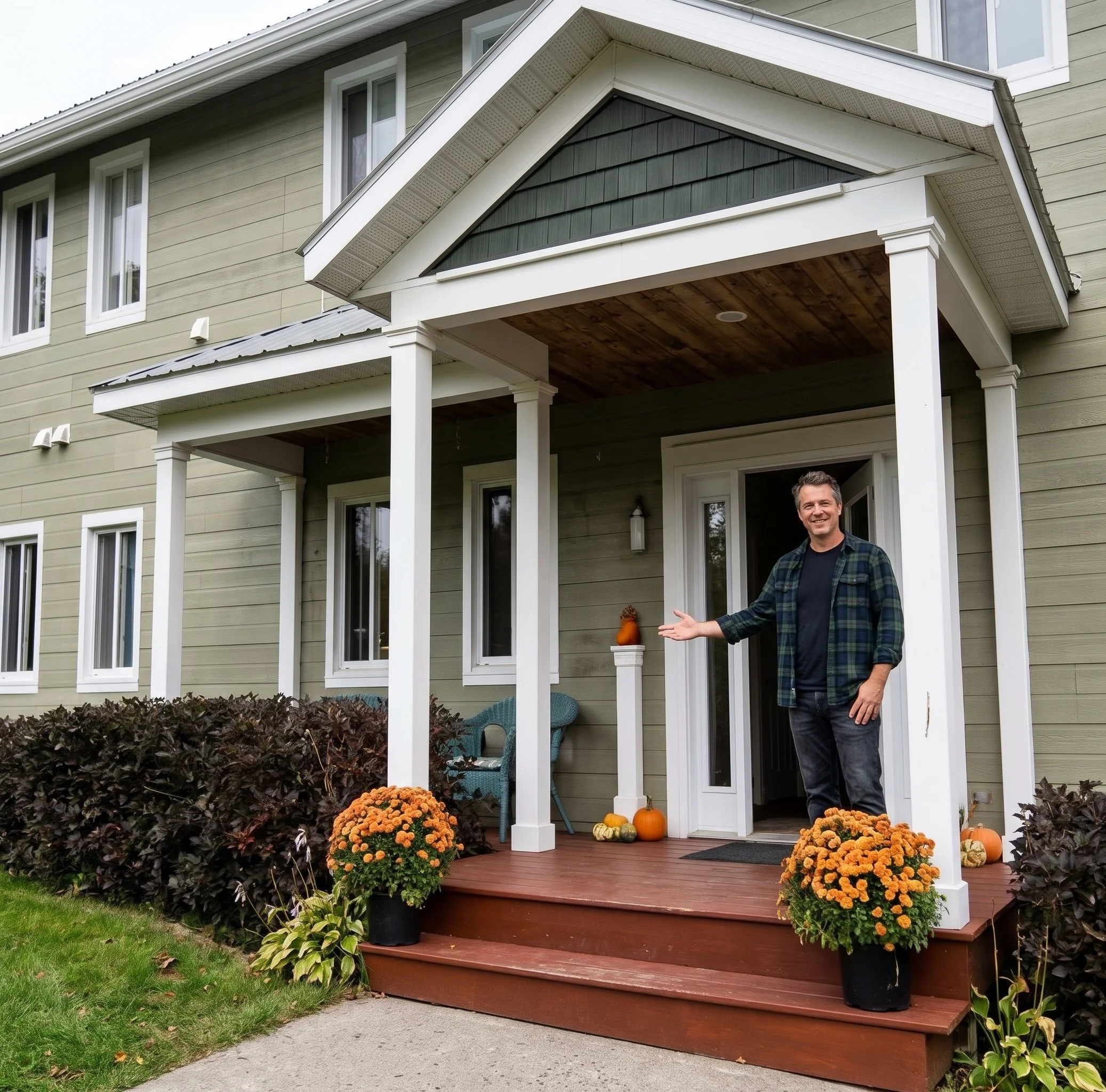
Dunham House
Residential care is appropriate in the case of drinking or drug use which keeps coming back despite genuine attempts to quit, in the case of deteriorating mental health, or where the stresses of home and work make it very difficult to make the change. At Dunham House men are cared for in English on a quiet 85 acre campus in the Eastern Townships of Quebec, in 30 day, 90 day or 6 month programmes.
Sometimes outpatient help is quite sufficient. Sometimes a man just needs to be away from the bar on his way home, away from the job, for a spell. Our post on when to consider residential care looks at the signs. Inpatient care for dual diagnosis explains what a residential stay adds.
What care looks like at Dunham House
We're about an hour and a half from Montreal down the back roads. In November the trails are muddy, then frozen, then white. Mornings are cold and quiet.
Every one of our programs is a dual diagnosis program (substance use and mental health are addressed together in English). You can choose from a 30-day program, a 90-day program or our 6-month program and there are outpatient services in Montreal for after. You can see the campus prior to you even call.
No detox on site. Detox is done prior to admission. Our admissions team will help you plan that and time your move into residential care.
Worried about yourself or worried about a man in your life? Call us at 450-263-1894. We'll listen and go over the options with you. No pressure at all and no commitment from one phone call. You can also just send us a message. Families, start here.
FAQ
Is November Men's Mental Health Month in Canada?
November is Movember and that's all about men's health (mental health and suicide prevention amongst other things). In Canada men are responsible for three out of every four suicides so it's a very good time of year to check in with the men in your life and have a proper chat about how they're getting on.
What is Movember and what does it support?
Movember is a global charity that runs in November and raises money and awareness for men's health with a particular focus on mental health, suicide prevention and prostate and testicular cancer. Men grow moustaches, move or run events to get the conversation going. The message is very straightforward: men are dying too young from preventable causes and talking about it makes a difference.
Why don't men ask for help with their mental health?
So many men learn very early on to be self-reliant, to brush pain under the carpet and to sort things out on their own. The stigma of asking for help is such that it's perceived as a form of weakness and so distress often manifests as anger, overwork or drinking rather than as words. The very first step in the direction of care is often to name what is going on and to realise that help is available.
What are the signs of depression in men?
In men it tends to present itself less as sadness and more as irritability, anger, withdrawal, fatigue, insomnia, risk taking and/or drinking and drug use. Some men will work longer hours in an attempt to avoid feeling anything at all. If any of these are present for more than two weeks and are affecting your work and/or relationships then it's time to see a professional.
Why do men self-medicate with alcohol or drugs?
So many men will use alcohol or drugs to quiet the anxiety, depression, trauma or stress. The relief is fleeting. The substances actually worsen the low mood and interfere with sleep, which in turn leads to more use. When a mental health condition and a substance use disorder co-exist it's referred to as a concurrent disorder and it generally makes sense to look after both of them in tandem.
How are depression and alcohol use linked?
Depression and alcohol use tend to go hand in hand. Alcohol can provide a short term fix, only to make the depression, sleep and anxiety worse. In Canada, alcohol use disorder is very common in people with major depression and those with alcohol use disorder are 3x more likely to have suicidal behaviour. It makes perfect sense to be treating both of these at the same time.
What is a concurrent disorder (dual diagnosis)?
A concurrent disorder (also known as dual diagnosis) is where a person has both a mental health condition (e.g. depression, anxiety, PTSD) and a substance use problem. The two conditions feed each other so integrated care looks at both at the same time rather than one on top of the other which in turn supports a more stable recovery.
How do I talk to a man that I care about who is going through a bit of a struggle?
Pick a quiet moment, a private one, and just say what you've noticed, without any blame at all: "You haven't seemed yourself recently." Listen more than you speak. Encourage one tiny step, one small action such as seeing a doctor or calling a helpline. Then follow up later to check in. Movember refer to this as ALEC: Ask, Listen, Encourage action, Check in.
When is residential care the right step?
Residential care is appropriate in the case of someone whose drinking or drug use keeps coming back despite genuine attempts to stop, someone whose mental health is deteriorating, or someone who is just simply unable to make the change due to the stresses of home and work. At Dunham House men are cared for in English on a quiet 85 acre campus in the Eastern Townships of Quebec in 30 day, 90 day or 6 month programs.
Is there any English language addiction care in Quebec?
Yes. Dunham House provides residential care in English for adults with co-occurring substance use and mental health issues. The program is 30, 90 or 6 months in duration and is based on an 85 acre campus in the Eastern Townships of Quebec (approximately 1.5 hours from Montreal). Detox is not provided on site and takes place prior to admission.
How long does residential recovery take?
It varies from person to person. Dunham House provides 30 day, 90 day and 6 month residential programs and the admissions team will work with the individual and their family to choose the right one. Recovery obviously continues after the residential program has ended, with many people moving into outpatient support and aftercare. The longer the stay the more time you have to work on the new skills before you go home.
Where can men in Canada get help at the moment?
If you or a man you know is in crisis or considering suicide, call or text 9-8-8 (Canada's Suicide Crisis Helpline) any time for free. If life is in immediate danger, call 911. For non-urgent help with substance use and mental health, call Dunham House at 450-263-1894.
Ready to talk? Call admissions at 450-263-1894, or contact us online.
If you or someone you know is in crisis: call or text 9-8-8 (Suicide Crisis Helpline, 24/7, free) or call 911 in an emergency. In Quebec you can also call 811 (Info-Social). This article is for information only and is not medical advice.
Sources
Public Health Agency of Canada, Suicide and self-harm key statistics: https://health-infobase.canada.ca/mental-health/suicide-self-harm/
Statistics Canada, More on the moustache: https://www.statcan.gc.ca/o1/en/plus/7369-more-moustache
Statistics Canada, Statistical checkup of Canadian men's health: https://www.statcan.gc.ca/o1/en/plus/6413-statistical-checkup-canadian-mens-health
Statistics Canada, Mental and substance use disorders in Canada (2012): https://www150.statcan.gc.ca/n1/en/pub/82-624-x/2013001/article/11855-eng.pdf
Mental Health Commission of Canada, Alcohol Use and Suicide fact sheet: https://mentalhealthcommission.ca/wp-content/uploads/2022/03/Alcohol-Use-and-Suicide-Fact-Sheet.pdf
Movember, mental health: https://ca.movember.com/about/mental-health
Movember Conversations (ALEC): https://conversations.movember.com/en/
9-8-8 Suicide Crisis Helpline: https://988.ca

Dunham House
About Dunham House
Located in Quebec's Eastern Townships, Dunham House is a residential treatment centre specializing in addiction and providing support to individuals with concurrent mental health challenges. We are the only residential facility of our kind in Quebec that operates in English.
Our evidence-based programs include a variety of activities such as art, music, yoga, and equine-assisted therapy. In addition to our residential services, we offer a full continuum of care with outpatient services at the Queen Elizabeth Complex in Montreal.