
How to Help a Family Member Who Refuses Treatment
Something just doesn't seem quite right. You feel it, you can see it, and you feel it in every misdirected discussion, every broken promise, and every instance where your loved one disappears behind the drugs or the alcohol. You've done your homework. You may even have a treatment facility picked out. Then comes that dreaded "No."
That "No" can feel like an obstacle wall. But the fact of the matter is, it's just the beginning.
This guide is for those families who are dealing with the hardest experience of all in addiction - trying to love someone who isn't ready for help.

Why Your Loved One Is Refusing Help
In order to offer meaningful support to a loved one, you first have to understand what is motivating their decision. Contrary to popular belief, people who live with addiction don't reject help because they want to continue living with addiction. There is a reason why they are choosing the path they have chosen, and understanding the reasons behind those choices is crucial to being able to help.
Some common reasons your loved one is refusing treatment include:
Fear of withdrawal. Withdrawal from a substance is incredibly physically and mentally taxing, especially when done without proper medical supervision.
Shame and stigma. Your loved one may be feeling a lot of pressure to keep up appearances and may be struggling with the shame associated with acknowledging addiction.
Denial. Believe it or not, many people genuinely don't believe that they have an addiction that would require treatment. This denial only serves to prevent them from making healthy changes.
Loss of control. Treatment often entails a loss of autonomy that people with an addiction struggle to let go of.
Co-occurring mental health conditions. Untreated depression, anxiety, post-traumatic stress disorder (PTSD), and other illnesses can create a barrier to treatment.
Bad past experiences. If your loved one had previously gone into treatment and failed, or simply had a negative experience with one program, the idea of returning may seem too much to bear.
These reasons should not be seen as reasons to justify their refusal, but rather as factors to take into consideration moving forward.
What Not to Do When Your Loved One Rejects Treatment
When someone you love is in the grips of an addiction, your immediate reaction may be to offer support. Unfortunately, there are several approaches to helping someone with addiction that will only serve to hinder their progress down the road.
Do NOT:
Make ultimatums that you aren't prepared to enforce. Setting up a boundary without the intention to hold that boundary does nothing except weaken the connection between you.
Act in an enabling manner in the name of love. Enabling can come in many forms; covering up their mistakes, helping them make excuses for themselves, or helping them pay back debts incurred because of substance abuse all serve to reinforce the behavior.
Shame or guilt trip your loved one. Making them feel bad for what they have done is unlikely to inspire change; it is much more likely to drive them further from you.
Wait for rock bottom. As counterintuitive as it sounds, waiting until someone hits rock bottom does not increase their chances of success in treatment. Early intervention leads to better outcomes.
Talk about how this makes you feel. Your feelings are understandable, and we'll talk about how to cope with those feelings shortly. But opening your discussion with your own problems puts you at a disadvantage.
How To Respond Effectively
There are many things you cannot do to change a family member's mind when it comes to treatment. Fortunately, there are just as many things you can do. While you can't force them to attend therapy sessions or rehabilitation facilities, you can provide the environment that will encourage them to change.
Here are some steps you can take:
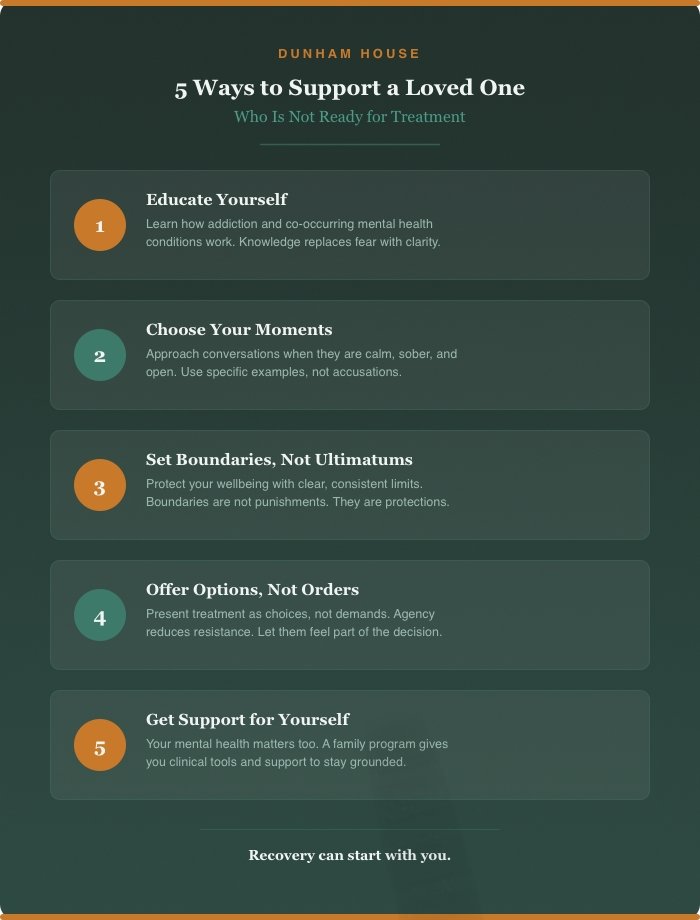
Educate yourself on addiction and related topics such as co-occurring mental health issues. Understanding how addiction works on a biological level makes it easier to communicate effectively about your loved one's condition.
Choose the right time to talk about difficult subjects. Talking to someone who is currently under the influence of their drug of choice, struggling with withdrawal symptoms, or emotionally unstable is a waste of time.
Show them what you are concerned about without making threats or ultimatums. Your role is not to judge or condemn. All you need to do is show your concern for their well-being in concrete terms.
Offer them options, not mandates. Instead of telling your loved one what they should do, offer a few different ways forward and ask which ones they find appealing.
Remain consistent with your message. One discussion about addiction and recovery may be enough for some people. Others will require many different discussions to finally see results.
Setting and Maintaining Healthy Boundaries

Boundary setting is one of the most challenging yet most important things you can do in this situation. Boundaries protect you from emotional and sometimes even physical harm. By learning to properly set and maintain boundaries with your loved one, you will give them a reason to take you seriously.
Healthy boundaries can include things like:
You love your family member, but you won't lend them money as long as they're abusing substances.
They are welcome in your home, but they must refrain from getting drunk when they visit.
Your goal is to support their recovery, but you're not going to lie and pretend like everything's fine anymore.
It is normal for your loved one to push back against the boundaries you set. Setting healthy boundaries is never easy. However, you must hold your ground in order to prove that you are serious.
If you are having difficulty creating or enforcing boundaries, we strongly recommend seeking professional help.
Why Professional Assistance Changes Everything

Family members of those who are living with addiction tend to try many different avenues before turning to professional help. Books, internet articles, meetings, and advice from others are all helpful to some degree. However, once certain obstacles appear in your way, you will need more specialized assistance.
Professional assistance can help you with such things as:
Learning more about the nature of your loved one's addiction and co-occurring mental illnesses.
Discovering ways of talking with your addicted family member that will help you connect with them on a deeper level.
Learning to distinguish enabling from supportive behavior.
Processing your grief, anger, frustration, and exhaustion in a safe space.
Building long-term strategies to help your family recover in spite of your loved one's current refusal to seek treatment.
At Dunham House, we have a dedicated Family Program that helps parents, spouses, children, siblings, and other loved ones learn how to navigate these challenges successfully. The program lasts for six weeks and includes both in-person and virtual classes that focus on equipping you with the tools to help your family member recover from an active addiction. (Please don't hesitate to get in touch to learn about the dates of the next cohort.)
You Also Deserve to Feel Better
This is easily the most important point of the entire piece, and you deserve to hear it.
Caring for someone with an active addiction takes its toll on anyone. You'll lose sleep, lose energy, suffer from chronic stress, and possibly develop other symptoms such as anxiety, depression, insomnia, and even PTSD. The best thing you can do for your addicted loved one is to get help for yourself as well.
By becoming educated, emotionally strong, and well-versed in the topic of addiction, you become a stabilizing factor in your family member's life. Over time, you may be able to sway them towards treatment with your presence alone.
Recovery Can Start Without Them Saying Yes
The idea that you have no power over the recovery process because your loved one said no is among the most harmful fallacies surrounding addiction. You may not be able to force your addicted loved one to get treatment, but you can take several other steps that will increase the likelihood of success exponentially.
Education, empathy, consistent discussions, and boundary setting can change the entire game in favor of recovery. You are the single most influential factor in the equation, despite having no control over the outcome.
If you are dealing with the problems we've described today, please remember: you are not alone in this fight.
Contact Dunham House now for more information about our programs call us directly at 450-263-3434.

Dunham House
About Dunham House
Located in Quebec's Eastern Townships, Dunham House is a residential treatment centre specializing in addiction and providing support to individuals with concurrent mental health challenges. We are the only residential facility of our kind in Quebec that operates in English.
Our evidence-based programs include a variety of activities such as art, music, yoga, and equine-assisted therapy. In addition to our residential services, we offer a full continuum of care with outpatient services at the Queen Elizabeth Complex in Montreal.