
5 Addiction Recovery Myths That Delay Treatment (and What the Science Shows)
There are five myths about addiction recovery which prevent people from getting treatment; although they may at first seem sensible when you compare them with clinical evidence, Dunham House staff hear all five during the first calls they receive from families.

You will know at least one person who has a problem with substances. Many of the people in your life can be described as having such a problem.
Every year in Canada, opioids and stimulants kill thousands. Alcohol kills tens of thousands more once you count liver disease, accidents, and cancers. Someone in your life fits inside those numbers. Their family noticed and waited. Their coworker noticed and said nothing. They noticed and figured they could handle it alone.
A large number of individuals postponed going into residential treatment since they held a wrong view of the possibility of recovery. These misconceptions have been caused by years of public information which has described addiction as a flaw of character, a moral failure, or a personal decision that has gone wrong. Clinicians note a situation that goes against the general beliefs of the public regarding substance use disorder. People die in the gap between what families think and what the treatment teams know.
On most of the first calls to Dunham House, five myths are mentioned.
Myth 1: Addiction Is Not a Willpower Problem

A parent makes the call and asks the same question again: "Why can't they simply stop?" knowing that their adult child has already tried to quit three, four, or five times.
The National Institute on Drug Abuse (NIDA) regards substance use disorder as a chronic brain disorder. Continued use of a substance alters the neural circuits responsible for the reward system, the response to stress, and self-control. These changes remain for months or years after the last instance of use. Studies using brain imaging have found that it takes 12 to 14 months of continuous abstinence for the density of dopamine transporters (which is a measure of the function of the reward system) to reach baseline levels.
You wouldn't ask a person who has type 2 diabetes to regulate their blood sugar just on the basis of determination, nor would you tell someone with hypertension to reduce their blood pressure by merely wanting to. Since both of those conditions involve biological dysfunction affected by genetics, behaviour, and the environment, substance use disorder does too.
A study published in the Journal of the American Medical Association in 2000 looked at the genetic heritability, pathophysiology, and treatment adherence associated with drug dependence alongside those of diabetes, hypertension, and asthma. The researchers discovered that the profiles were similar for all four conditions and that most employers provide sick leave for three of them whereas for the fourth you are fired.
At Dunham House the clinical team base their treatment on what neuroscience shows to be true, namely that your brain needs time, some structured support and therapeutic intervention if the pathways which substance use has disrupted are to be rebuilt; willpower is involved in making the decision to get help, after which over to the clinical care.
Myth 2: You Don't Need to Hit Rock Bottom for Rehab

Families wait because they think their loved one hasn't fallen far enough yet. No clinician uses "rock bottom" as a threshold for treatment. If substance use has changed how someone makes decisions, shows up for work, or treats the people closest to them, they qualify now. A clinical assessment opens doors to residential programs, medication-assisted treatment, counselling, harm reduction. Waiting for a crisis gives the disorder more time to entrench.
At Dunham House we have professionals in their thirties and forties who are still in work, keep up their relationships, and are functioning sufficiently so that no one suspects just how serious the situation is. Most of those who come in say something to the effect of 'I didn't think I was bad enough for this'. By the end of their first week they realise how much energy they had been spending on maintaining appearances. The disorder was already well developed and the obvious effects had not yet appeared.
If you're asking whether the person you care about is suitable for residential addiction treatment, the answer has nothing at all to do with how far they've dropped down. Instead ask yourself if their substance use has altered their personality, their decision-making, and their ability to be present for the things that used to be important? If the answer is yes, then treatment should now take place.
Myth 3: Rehab Is the Start of Recovery, Not the End
There is a widespread misconception that rehabilitation involves a single fix; you enter the situation in a broken state, leave it in a repaired one, and then go back to normal life. This approach works in the case of a dislocated shoulder but does not work when dealing with chronic conditions.
NIDA classifies addiction as a chronic, treatable disorder, comparable to heart disease or asthma. Treatment manages the condition. It does not eliminate it. Clinicians combine behavioural therapy, counselling, and (where applicable) medication into a sustained care plan. You reduce or stop using, build strategies for managing relapse triggers, and rebuild your daily routine. This takes time, structured support, and practice.
A 2026 review in Frontiers in Molecular Neuroscience synthesized five years of neuroplasticity research (2020-2025) in people recovering from substance use disorder. The authors confirmed that the brain adapts during recovery, but unevenly and on no fixed schedule. A 28-day program doesn't reset your neural pathways. You rebuild them over months through sustained sobriety, active therapeutic work, and consistent support from people around you.
At Dunham House we have residential programs that last one month, three months or six months since the time scale required for recovery varies from person to person. The six-month program is intended for clients with dual diagnoses (that is, those who have both a substance use and a mental health disorder) because their treatment has to take account of both conditions at the same time; treating one without the other would result in incomplete treatment.
After treatment, our clinical team draws up aftercare plans for each client, including outpatient therapy, links to peer support, family counselling, and relapse prevention techniques which are tailored to the client's specific triggers. The residential stage has the effect of stabilising brain chemistry and setting up a routine. Since both of these aspects need to be maintained, structured aftercare is required for a period of 12 months or longer.
If you'd like to discuss it, you can get a confidential consultation from Dunham House regarding residential treatment options in the Eastern Townships, Quebec by calling 450-263-3434.
Myth 4: Relapse Is a Clinical Signal, Not a Failure
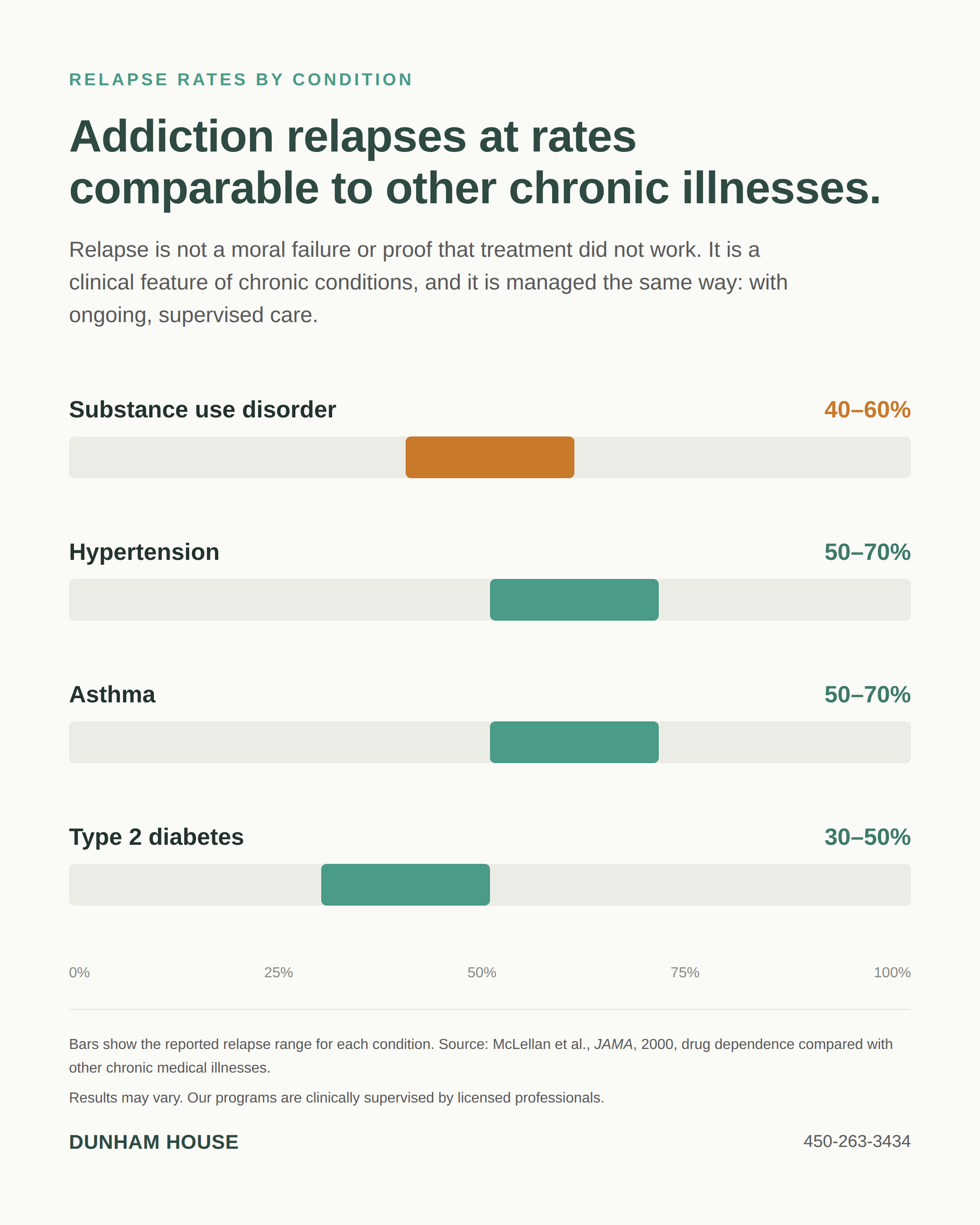
Between 40 per cent and 60 per cent of individuals in recovery have at least one relapse; this figure is similar to the relapse rates for patients with hypertension (50 to 70 per cent), asthma (50 to 70 per cent), and Type 2 diabetes (30 to 50 per cent). Just as you would not regard a person with diabetes who had eaten badly over the holidays as having failed, the same standard should apply in this case.
If a person relapses, their clinical team will reassess the treatment plan. It is possible that the dosage of a medication needs to be altered. It might be that an underlying mental health condition was not dealt with during the first round of treatment. It could be that the client's environment after treatment caused triggers to reappear more quickly than their coping strategies were able to cope with.
Established clinical guidelines describe relapse as a process with three stages: emotional relapse (characterized by isolation and poor self‑care), mental relapse (involving internal conflict about substance use), and physical relapse (the actual return to use). Because clinicians recognize this progression, they can intervene at the emotional or mental stage, before substance use resumes.
We aim at Dunham House to get our clients ready for this situation as part of their treatment. If you pretend that a relapse is impossible it becomes more dangerous when one actually does occur. Clients are able to recover more quickly after a setback when they know the warning signs, have practised phoning their counsellor in Stage 1 and have a plan covering the first 72 hours of a crisis.
The situation is also important for families; if you anticipate progress that is steady and gradual, then a setback seems catastrophic. But if you accept the chronic disease model, you will be able to support your loved one during a relapse without seeing it as evidence that the treatment has failed.
Myth 5: People Recover From Substance Use Disorder

You learn of relapses because the journalists report on them, whereas you never hear about the accountant from Sherbrooke who finished her treatment four years ago and is now coaching her daughter's soccer team; there is no coverage of that story.
SAMHSA surveyed over 67,000 Americans for the 2024 National Survey on Drug Use and Health. Of adults who reported a past problem with alcohol or drugs, 74.3 percent (roughly 23.5 million people) said they now consider themselves recovered or in recovery. Recovery looks different depending on the person. Some maintain full abstinence. Others reduced their use, stabilized their mental health, rebuilt relationships, or got back to work.
The alumni network at Dunham House comprises people who have gone back to work, parents who have rearranged their custody arrangements, and couples who have managed to repair marriages that were about to end. These kinds of results are seen among most clients who finish the full program length that their clinical team has recommended.
The fact that we are based in the Eastern Townships is important; the residential setting we have in Quebec puts our clients away from the environments, relationships, and routines which had reinforced their substance use, so that distance from triggers allows the brain room to set up new patterns before having to face real-world pressures.
When to Seek Residential Addiction Treatment in Quebec

All of these misconceptions function in the same way: they cause a delay in taking action. For example, a family member who believes that willpower is enough will not start looking into treatment options until a year later, while a professional who thinks they haven't reached bottom loses another promotion, another relationship, and another part of their health.
Make this misconception go away when talking about the person you love by providing correct information. Pass on this article. Refer to it in conversation. Fix the myth whenever you hear it mentioned.
If you want to find out more about residential addiction treatment for yourself or a member of your family, Dunham House provides confidential consultations with our admissions team in the Eastern Townships, Quebec. We will answer any questions you have without putting pressure on you, assist you in understanding what residential treatment consists of, and determine whether our one-month,three-month or six-month program is suitable for your case.
Call 450-263-3434 or email admissions@dunhamhouse.ca. The conversation is free. That call might be the thing that makes someone in your life seek help six months earlier than they otherwise would.

Dunham House
About Dunham House
Located in Quebec's Eastern Townships, Dunham House is a residential treatment centre specializing in addiction and providing support to individuals with concurrent mental health challenges. We are the only residential facility of our kind in Quebec that operates in English.
Our evidence-based programs include a variety of activities such as art, music, yoga, and equine-assisted therapy. In addition to our residential services, we offer a full continuum of care with outpatient services at the Queen Elizabeth Complex in Montreal.